
Bamboo in Japan: From Flood Protection to Traditional Crafts
Bamboo isn’t just an attractive backdrop in Japan.. Its practical uses help explain why bamboo was prized and carefully managed.
Bamboo is not just an attractive backdrop in Japan. On the Yoshino River in Tokushima, bamboo groves were planted to limit erosion and reduce flood damage. Across western Japan, the plant also became essential to local industries, from Marugame’s hand-made fans to bamboo crafts in Beppu and tea whisks in Nara. Its practical uses help explain why bamboo was prized and carefully managed.
Bamboo and the Yoshino River
Along the Yoshino River in Tokushima Prefecture, bamboo has a history that goes well beyond its use as a building material or garden plant.
The river was difficult to control. During the feudal period, the authorities didn’t have the resources to construct continuous embankments capable of containing its floods, so they encouraged the planting of bamboo along the banks.
Bamboo spreads through underground stems that bind the soil together. Dense stands also slow the movement of floodwater and help keep large stones and gravel away from farmland. Fine sediment can pass through the bamboo, depositing fertile soil on fields.
These plantings became part of the local approach to flood management. They also supplied material for local industries, including the manufacture of rulers and traditional paper umbrellas.
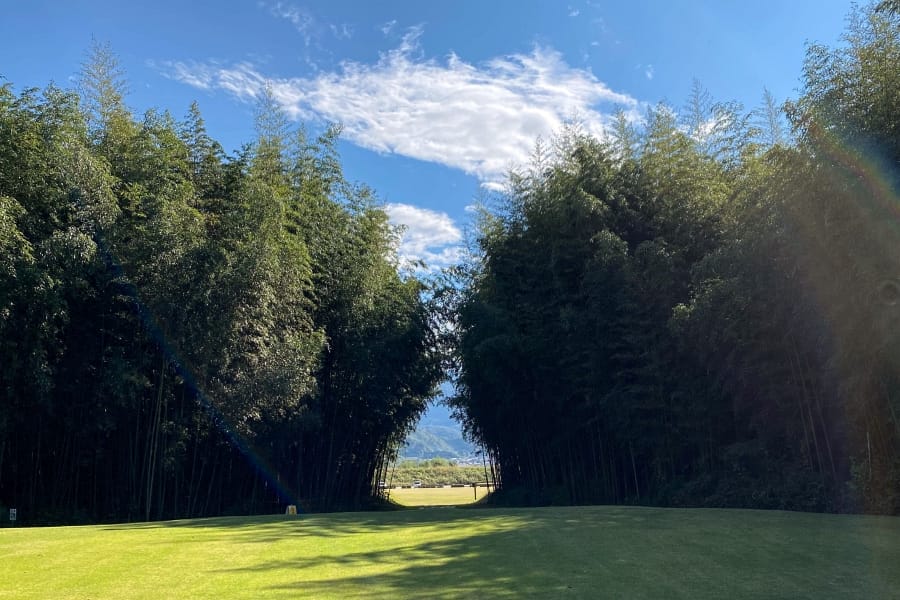
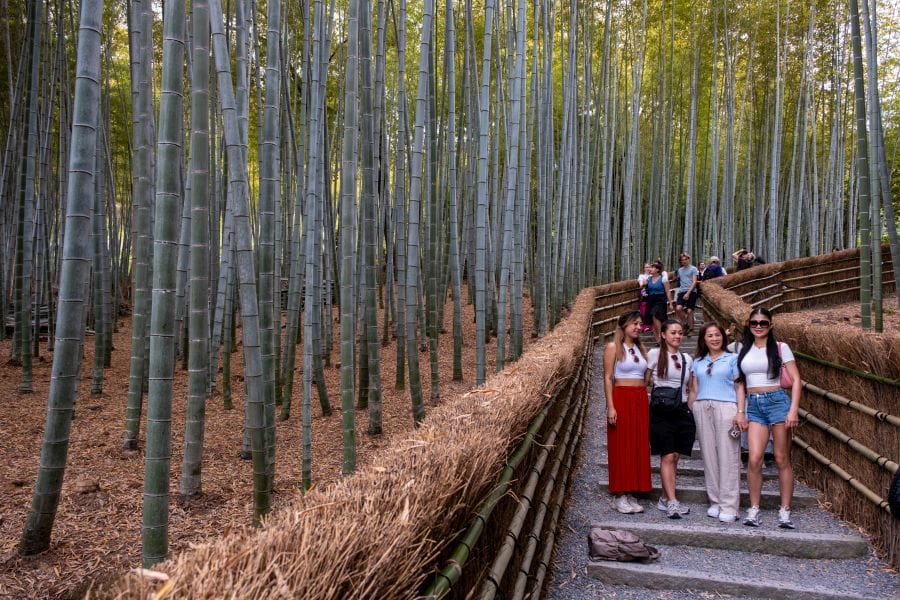
The Yoshino River is a useful example of how bamboo could serve several purposes at once. It helped protect farmland, provided a renewable supply of material and supported industries that depended on it. If you have a bicycle, you can cycle for miles through tunnels of unmanicured bamboo beside the great river.
Marugame fans: A Shikoku industry built around bamboo
Marugame, in Kagawa Prefecture, is known for its traditional hand fans. Their history is closely connected to travel and pilgrimage in the Seto Inland Sea region.
The craft developed during the Edo period, when fans were made as souvenirs for people visiting Kotohira Shrine, one of Shikoku’s major religious destinations. The local feudal government later encouraged fan-making as a source of income for its samurai retainers.
Bamboo forms the fan’s framework. A single length is split and shaped into narrow ribs, which spread out to support the paper covering. Producing a finished fan requires numerous stages of careful cutting, shaping and assembly.
Marugame’s tradition also reflects the connections between the old provinces of Shikoku. A local saying describes how bamboo from Iyo, in present-day Ehime, paper from Tosa, in Kōchi, and paste from Awa, in Tokushima, came together to make fans in Sanuki, the old name for Kagawa.
This is a particularly good example of a traditional industry that cannot be understood in isolation from the surrounding region. The materials came from nearby areas, while pilgrimage brought customers and helped establish Marugame’s reputation.
Bamboo crafts in Beppu
Beppu in Ōita Prefecture is widely known for its hot springs, but it also has an established bamboo-working tradition. Beppu bamboo craft is recognised as a traditional Japanese craft, with products ranging from everyday baskets to intricate works of art.
Making a basket begins long before the weaving itself. Bamboo has to be selected, cut and split into strips of the appropriate width and thickness. The strips are then prepared and woven into the desired shape.
The material is strong but flexible, allowing craftspeople to produce objects that are both lightweight and durable. Different weaving patterns create different structures, from open baskets that allow air to circulate to tightly worked designs intended to hold their shape.
Beppu’s bamboo craft has changed along with everyday life. Plastic products displaced many traditional household objects, but craftspeople continued to develop more elaborate work and new designs. Today, the tradition encompasses both practical objects and pieces intended primarily for their artistic qualities.
The Beppu City Traditional Bamboo Crafts Center provides an opportunity to see this work and learn more about the techniques involved. It is an interesting stop for anyone visiting Kyūshū who wants to look beyond the region’s better-known hot-spring attractions.
Tea Whisks from Nara
In Takayama, in Nara Prefecture, bamboo has been used for centuries to make the whisks used in the preparation of matcha.
A tea whisk must do more than simply stir. Its thin prongs need to be flexible enough to mix powdered tea with hot water and produce a fine foam, yet strong enough to withstand repeated use.
Making one involves splitting and shaving a piece of bamboo into numerous narrow prongs. The cuts must be controlled carefully so that the prongs are fine and even without becoming too fragile.
The choice of bamboo matters. Hachiku, which splits readily into narrow strips, is particularly suited to this kind of work.
The result is a small object whose design depends on an intimate understanding of the material. It also illustrates how different types of bamboo have developed specialised uses rather than serving as interchangeable building materials.
Bamboo Inside Japanese Castle Walls
Bamboo is less obvious in traditional buildings, because much of it is concealed inside the walls.
At Kanazawa Castle, traditional earthen walls are built around a framework of bamboo poles tied together with straw rope. Earth is applied over this lattice in layers, then finished with plaster.
The bamboo provides a supporting framework for the earthen material. The finished wall is substantial, with a structure that combines timber, bamboo, earth and plaster rather than relying on a single material.
The exterior of Kanazawa Castle’s walls is also distinctive. Some sections have tiles attached to the lower part, with plaster filling the joints to create a patterned surface. This finish, commonly found on traditional walls in the region, protects the structure from the weather.
Bamboo’s role is hidden, but essential to the construction method. Without it, the earthen material would not have the same supporting framework.
Similar bamboo lattices have been used in traditional earthen walls elsewhere in Japan. The technique shows how a plant that grows readily in the countryside became part of the architecture of castles, houses and other buildings.
Why bamboo groves need management
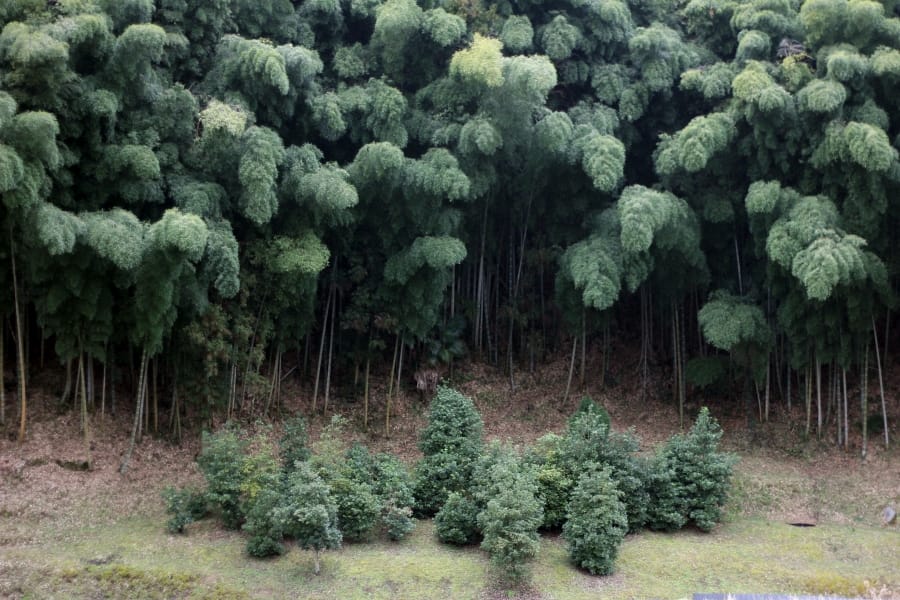
The rapid growth that made bamboo so useful can also cause problems. Bamboo can spread beyond its original planting, particularly when groves are no longer regularly harvested or maintained.
Changes in rural life and the arrival of cheaper manufactured materials reduced demand for many traditional bamboo products. Some groves were consequently neglected, allowing bamboo to spread into former farmland and surrounding woodland.
Not every bamboo grove is a problem, and many remain productive or carefully maintained. But unmanaged stands can shade other vegetation and become difficult to clear, especially where land has been abandoned.
This is an important part of bamboo’s story in Japan. The plant was not simply allowed to grow wherever it pleased: people planted it, harvested it and found uses for its stems. The decline of those uses changed the landscape.
A material Shaped by its uses
Bamboo’s importance in Japan is easiest to understand through particular places and the work carried out there.
Along the Yoshino River, it formed part of a system for protecting farmland from floods. In Marugame, it became the framework for fans sold to pilgrims. In Beppu and Takayama, craftspeople developed specialised ways to turn it into baskets and tea utensils. At Kanazawa Castle, it forms part of a building technique that is not immediately visible from the outside.
These uses reflect the properties of bamboo, but also the needs of local communities. A plant that grows quickly and can be split into useful lengths became a practical resource, supporting crafts and industries across Japan.
Its place in the landscape today still reflects that history. A bamboo grove may be an attractive feature of a garden, a source of material for a working craft or the legacy of an older agricultural system.