Richard Cocks
Name In Japanese: リチャード・コックス
Pronunciation: richardo cokusu
Period: 1565 to 1624
The history of the first English trading post in Japan is largely preserved through the meticulous, often frustrated, entries in the diary of Richard Cocks. Appointed as the chief merchant, or factor, in 1613, Cocks oversaw a decade of commercial struggle on the island of Hirado. His journals offer a granular view of the challenges faced by the East India Company, moving beyond trade data to record the friction of daily life in a foreign port. He spent much of his tenure navigating the complex social and legal landscape of the Tokugawa Shogunate while attempting to outmanoeuvre European rivals who had already secured more favourable positions.
Cocks’s relationship with other European factors was defined by a volatile mix of professional hostility and personal socialising. While the English and Dutch were ostensibly allies against Spanish and Portuguese Catholic influence, the reality on the ground was often one of bitter competition and occasional violence. Cocks frequently recorded his ire toward the Dutch, whom he accused of trying to “eat the English out of their trade” by undercutting prices and manipulating local officials. Despite this, the small community of Europeans in Hirado meant that Cocks often found himself dining and drinking with the very men he disparaged in his official reports, maintaining a veneer of civility that masked deep-seated corporate animosity.
A significant portion of Cocks’s recorded leisure time involved the consumption of local spirits, providing some of the earliest English accounts of distilled beverages in Japan. He took a particular interest in what he recorded as “shochu,” a clear distilled spirit typically made from rice or sweet potatoes. In his entries, Cocks noted that this “strong water” was often served at social gatherings and was used as a gift to curry favour with local lords and officials. His descriptions suggest that while the English merchants preferred their own imported wines and ales, they frequently turned to the local spirit as a practical, and potent, alternative during their long isolation.
The eventual collapse of the English factory in 1623 brought Cocks’s professional conduct under severe scrutiny. He was accused of gross mismanagement and extravagant feasting and womanising, with the East India Company’s leadership in Batavia claiming that he had allowed the post to descend into a state of bankruptcy through negligence. The most serious wrongdoing he was charged with involved a massive deficit in the factory’s accounts, partly attributed to his decision to lend substantial sums of money to Li Dan, a powerful Chinese merchant, in a failed attempt to secure trade rights with China. These loans were never recovered, leaving the English operation in ruins.
When an auditor arrived in Hirado to settle the accounts, the scale of the financial disaster led to the immediate closure of the trading post. Cocks was ordered back to London to face a formal trial for his failures. The Company’s records from this period paint a picture of a man who had lost control of his subordinates and allowed the factory to become a site of personal indulgence rather than commercial enterprise. However, Cocks never reached England to defend himself; he died of illness aboard the Anne Royal in 1624 and was buried at sea in the Indian Ocean.
Beyond the financial scandals, Cocks left a physical legacy on the Japanese landscape that persists in an unexpected form. He is credited with one of the earliest recorded instances of planting the sweet potato in Japan, having received the tubers from the English pilot William Adams. Cocks cultivated them in the factory garden in Hirado, recording their growth in his diary alongside his complaints about trade. While his commercial ambitions ended in disgrace and his accounts in red ink, his botanical contribution eventually became a staple crop across the country, outlasting the short-lived English presence on the island.
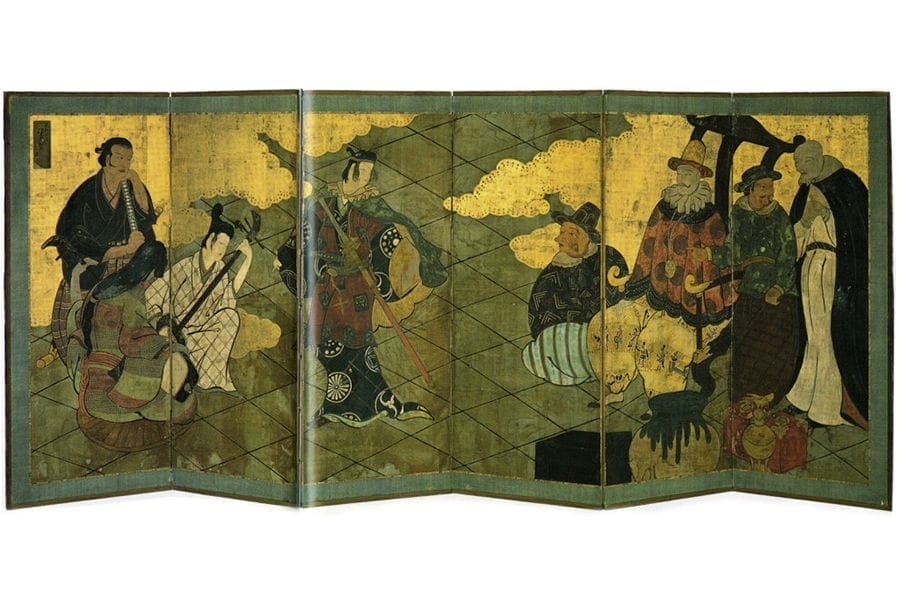
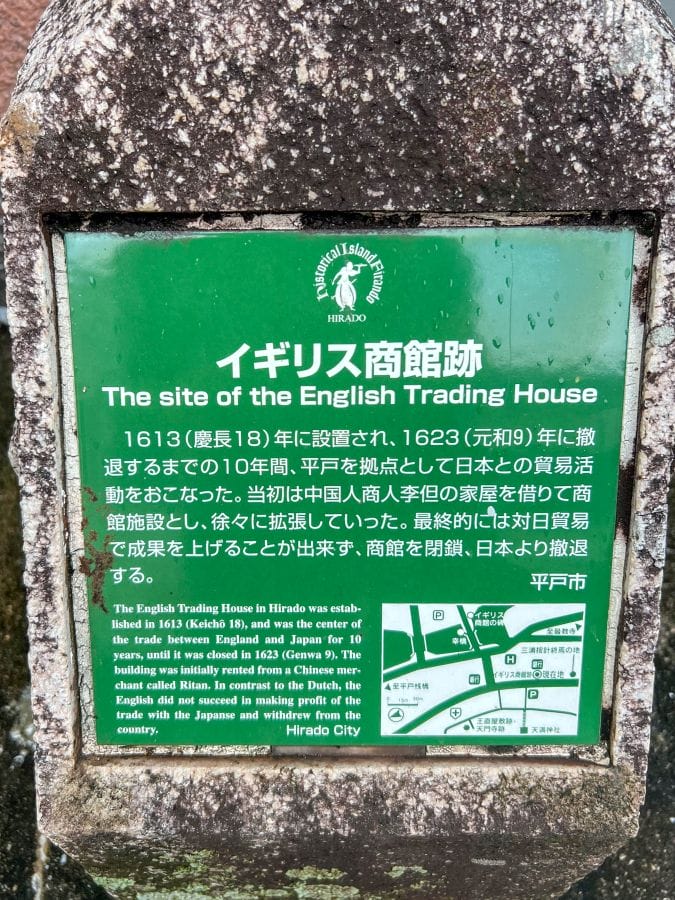
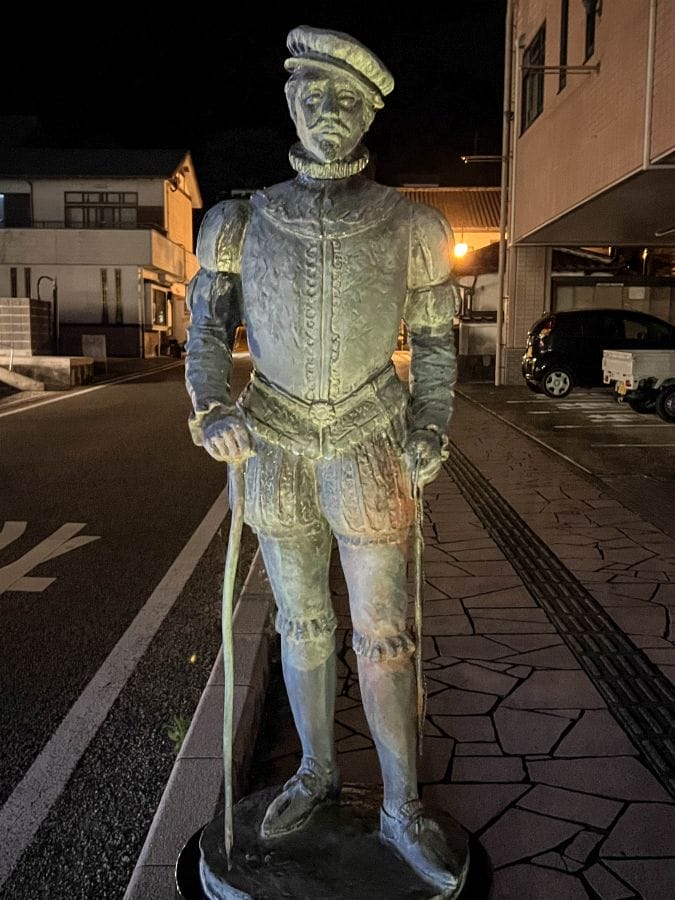
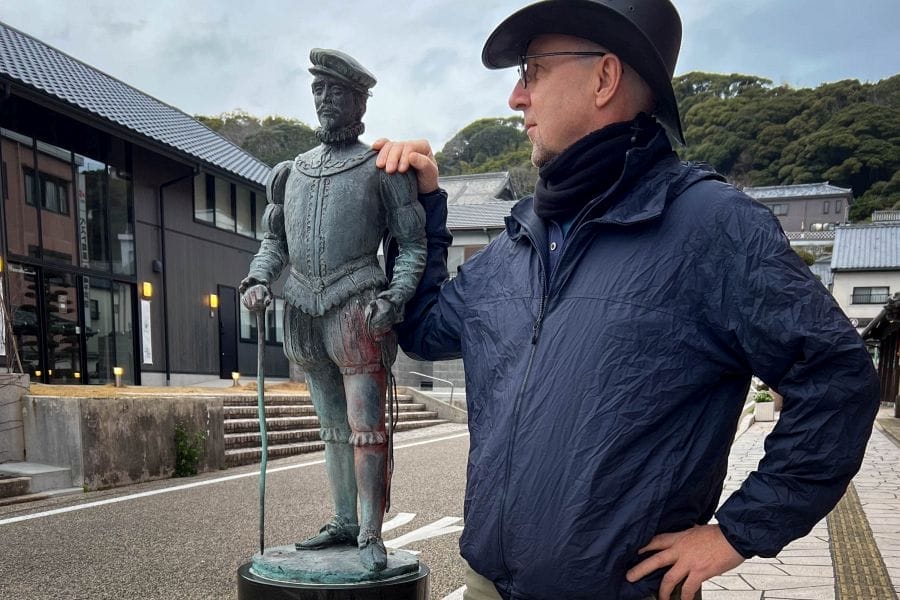
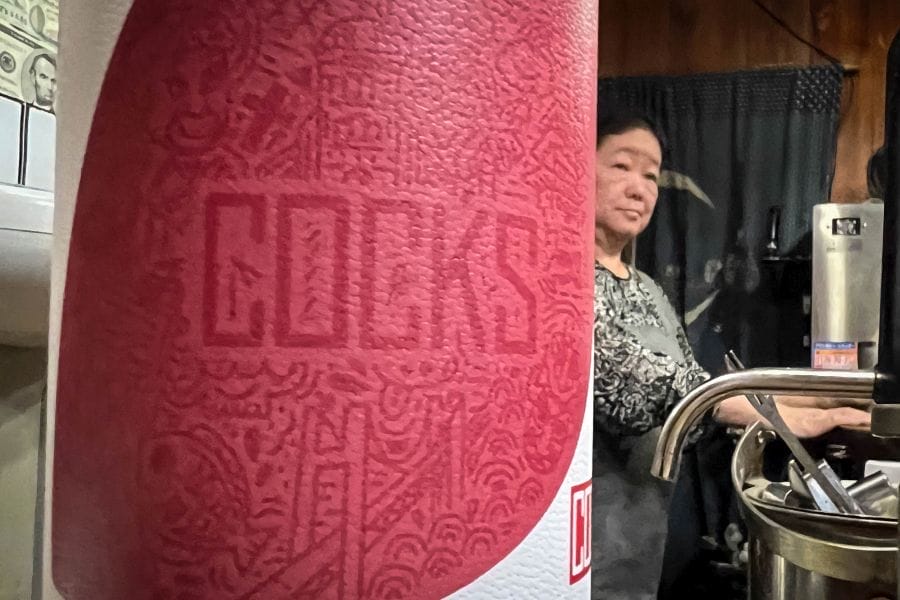
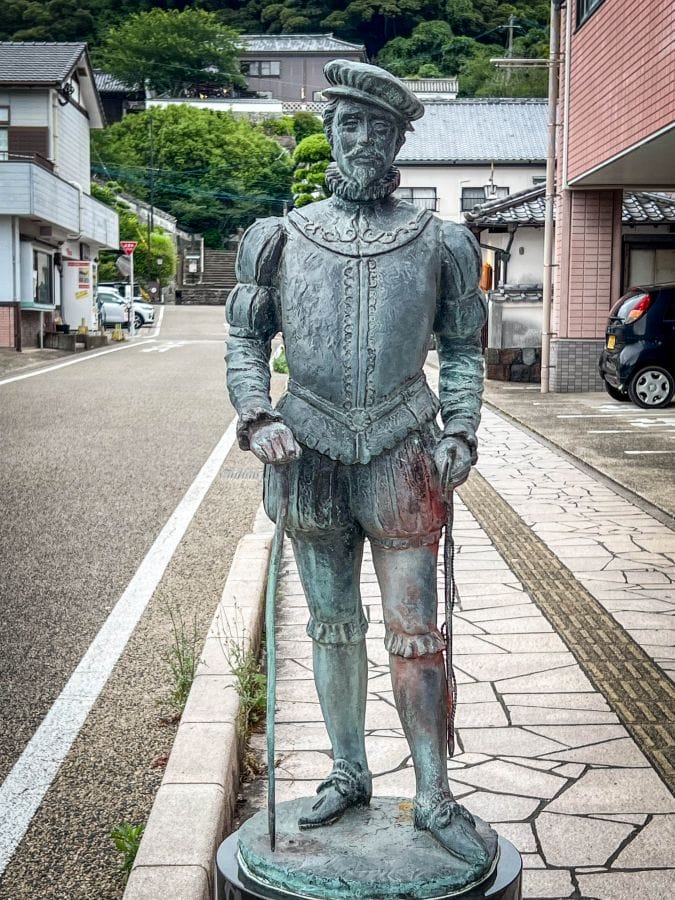
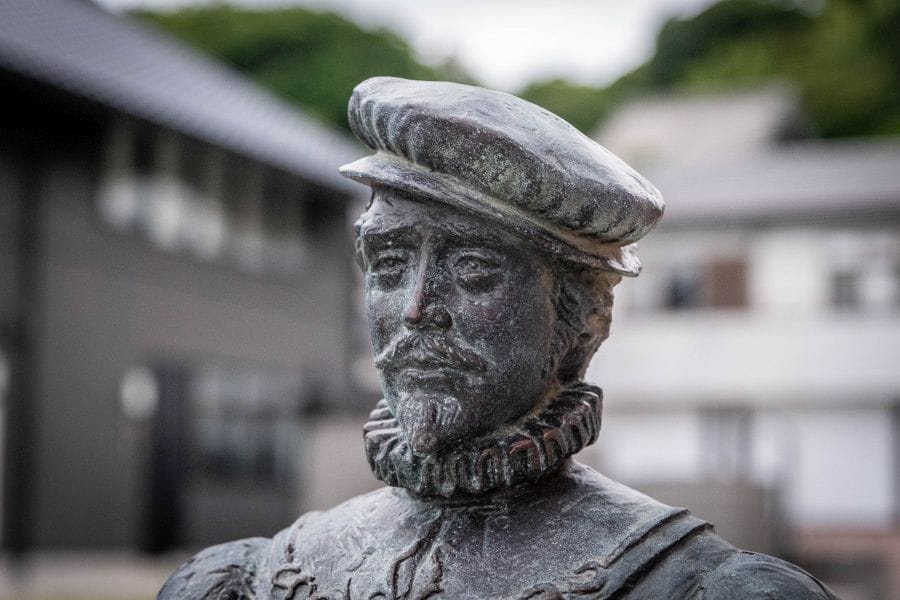
In Hirado on the street leading to Matsuura Historical Museum is a small bronze statue of Cocks dressed as an Elizabethan gentleman, and a small sign on Hirado’s high street marks the site of the English trading house. In 2013, a screen depicting Cocks was installed in St Chad’s Church, Seighford, Cocks’ baptismal church, to commemorate 400 years of Japan-British relations. Fukuda Brewery in Hirado makes a delicious potato shōchū called simply “Cocks” to honour the potato-growing factor. It’s enjoyed in the small bars and restaurants on the streets that Cocks once walked.