Temple 79, Tennō-ji
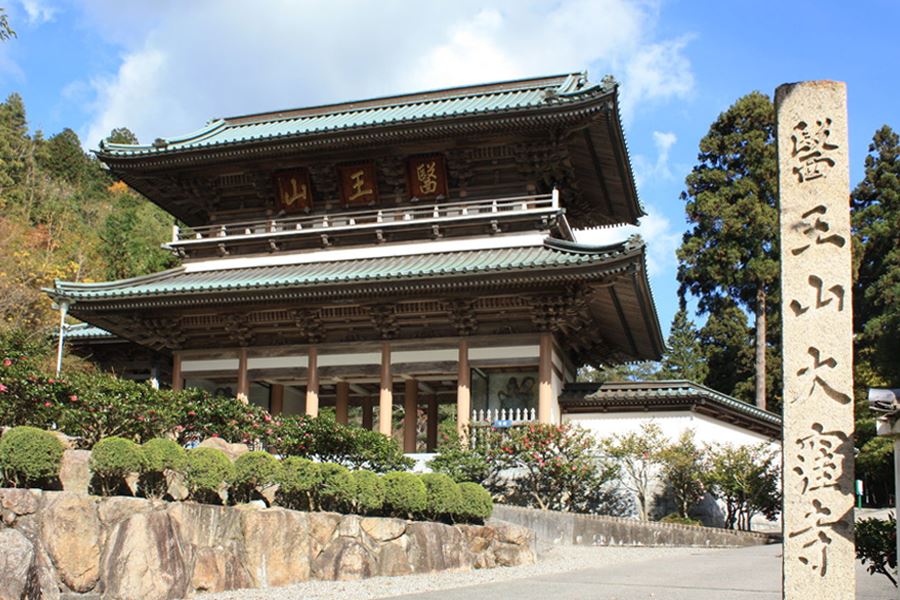
Tennō-ji is temple No. 79 on the Shikoku pilgrimage, or Henro. Its name derives from the fact that Sutoku Tennō (Emperor Sutoku) lay in state here after his death in 1156, following banishment from Kyōto after his attempted coup against his brother. The temple is nestled in a valley near the Inland Sea in Sakaide. It stands at the foot of Mt. Kanayama, a mountain known as a source of metal ore for centuries.
What to see
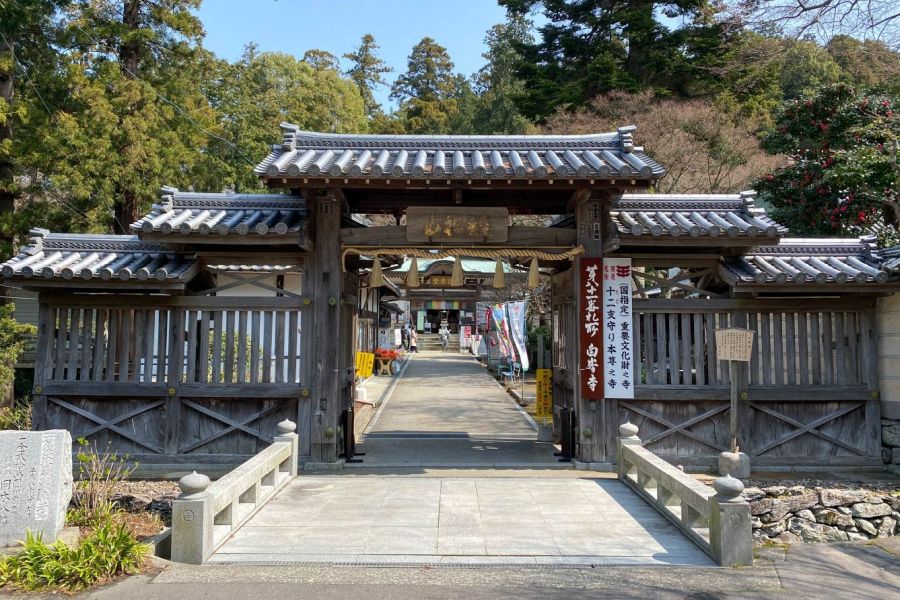
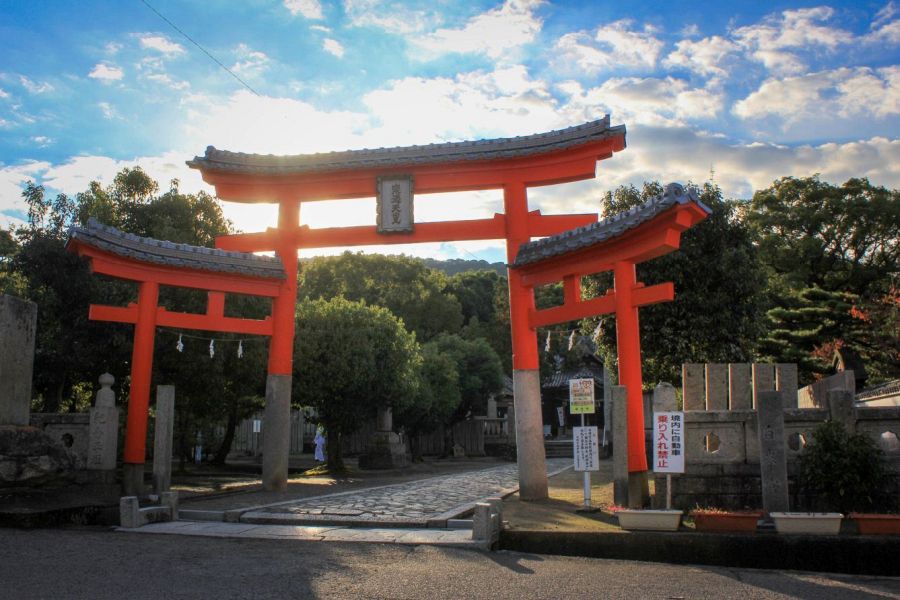
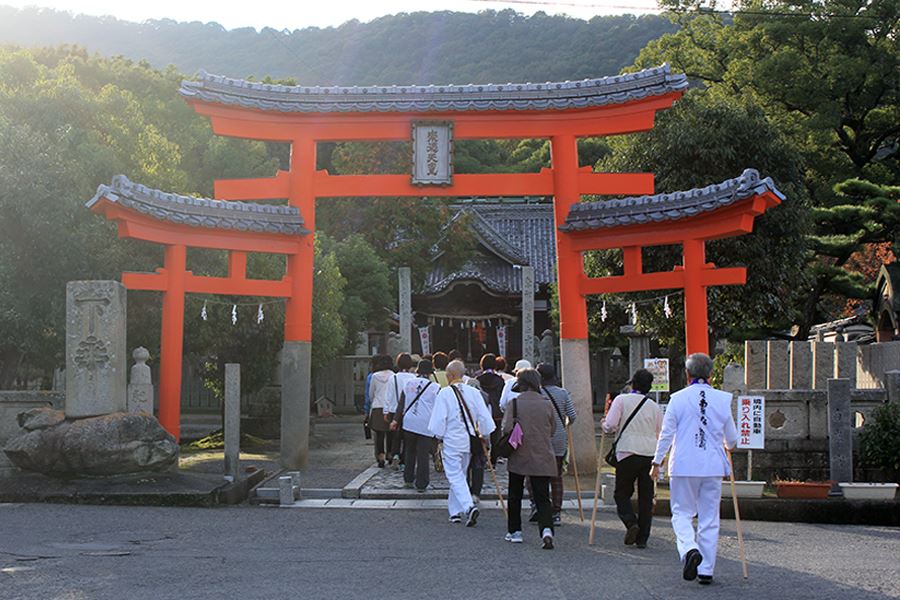
Unusually for a temple, the main gate is a red Miwa torii gate, itself of an unusual four-legged kind, reflecting the temple’s origin as a Shintō shrine. The plaque bears the inscription ‘Emperor Sutoku’, while the pillars are inscribed with ‘1734, Joint Effort of Parishioners, Current Head Priest: Hōgen-dai’.
Directly ahead of the torii gate is Shiromine Shrine. A turn to the left before it leads to the main hall of Tennō-ji. Its images are not on display, but plaques inscribed with ‘Vajra Realm Dharma Discourse’ and ‘Womb Realm Dharma Discourse’ are hung on the front and back of the hall, allowing worship from both sides. The Daishi Hall is to the left of the main hall.
To the side of Shiromine Shrine is the Manishu-in Daishi Hall.
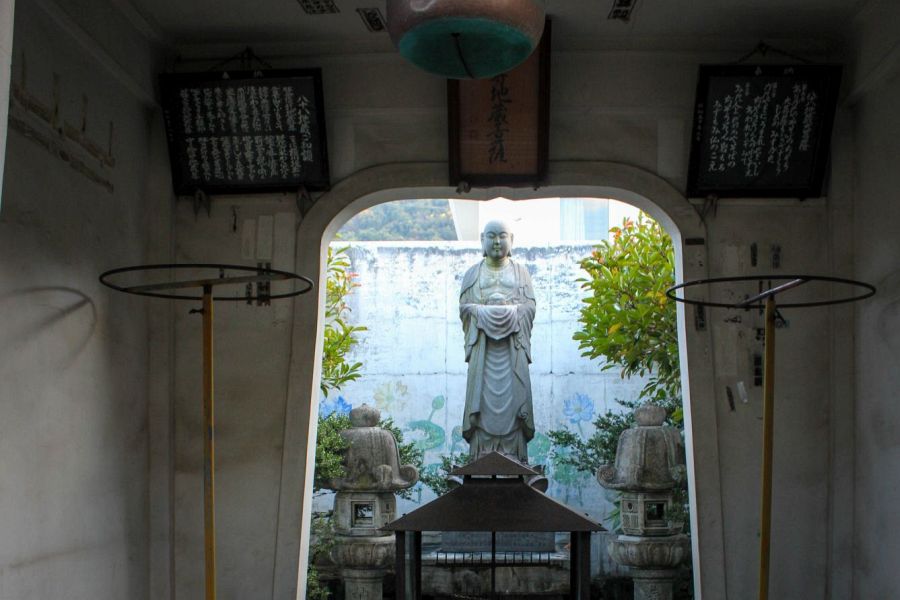
Exiting the Miwa torii gate and entering from the left leads to the priest’s quarters, with the temple office to its right. If you pass to the right of the main hall of Shiromine Shrine and proceed along the road through the precincts to the rear for about 500 m, you reach the sacred Yasoba spring associated with the temple’s founding, and a small Jizō Hall.
History
The foundation of the temple is shrouded in legend, but it was said to have been founded by Gyōki and restored by Kūkai.
Later, in the Hōgen Rebellion of 1156, the retired Emperor Sutoku was defeated and exiled to Sanuki Province. He spent his first three years in the relative comfort of a palace. He was transferred to this location when circumstances necessitated stricter supervision. After over six years of confinement, Sutoku died in 1164. His guards sent to the capital asking what to do with the emperor’s remains, which meanwhile lay in a golden coffin immersed in the cold waters of the sacred Yasoba spring. Thanks to their miraculous properties, even after twenty-one days had passed, Sutoku’s face appeared as though he were still alive. Every night during this time, a divine light emanated from the vicinity of the emperor’s residence, causing the forest to glow. Eventually, the reply arrived, and Sutoku was taken to nearby Mt. Shiromine for cremation and burial. This is the site of Temple 81, Shiromine-ji where you can still see his mausoleum. Then ruling Emperor Nijō decreed that a hall be erected at the place of his demise.
Shortly after Sutoku’s death, various calamitous wars and natural disasters began to afflict Japan, and it came to be thought that Sutoku had been treated with unjust harshness, causing him to become a vengeful spirit or onryō. Consequently, to placate Sutoku, his spirit came to be heaped with honours that had been denied the man himself.
Later, in 1244, the Shrine of Emperor Sutoku was rebuilt by imperial decree of Emperor Go-Saga. Manishu-in became the temple responsible for the perpetual memorial services for Sutoku. Consequently, people came to call Manishu-in ‘Tennō-ji’, the Emperor’s Temple.
Shortly before the Meiji Restoration, by imperial decree of Emperor Meiji, the spirit of Sutoku was returned to Shiramine Shrine in Kyōto. Sutoku Tennō Shrine ceased enshrining the retired Emperor Sutoku and was renamed Shiromine Shrine. Furthermore, the decree for the separation of Shintō and Buddhism in the early Meiji period compelled temples within shrine precincts to relocate or be abolished. The new government also took a hard line against temples under the temple patronage system, leading to the abolition of Manishu-in. However, the head priest of Manishu-in was appointed as the first shrine priest, and the 79th pilgrimage temple was taken over by nearby Kōshō-in. In 1887, after the disruption of the separation of Shintō and Buddhism had subsided, Kōshō-in relocated to the present site of Manishu-in’s former grounds, becoming Tennō-ji Kōshō-in.
Legends
In ancient times, when the warrior Sannō Reo and 88 samurai set out to subdue a great sea monster in the Inland Sea, their ship was swallowed by the monster and they perished. At that moment, the deity Yokoshio Myōjin appeared, bringing water from a spring at the foot of Mt. Kanayama. The samurai drank the water, and all were revived and saved. Thereafter, the spring came to be known as the Sacred Water of Yasoba.
When Kūkai visited the Yasoba spring, a celestial child — the incarnation of the Kanayama Gongen deity — appeared. Drawing water from the sacred well, the child served Kūkai and entrusted him with a jewel, instructing him to protect the Buddhist teachings of the mountain. Kūkai buried the jewel on the mountain, restored the dilapidated temple buildings, and named the temple Manishu-in Myōjōju-ji. He carved three images from sacred timber and thereafter the temple flourished as a place of pilgrimage.
It’s said that if you follow the formal route through the sacred space, you’ll receive triple the blessings.
Information
Name in Japanese: 天皇寺
Pronunciation: ten-nō-jee
Address: 1713-2 Nishinoshocho, Sakaide, Kagawa 762-0021